How Do Spiders Travel? From Ballooning to Underwater Living
Spiders get around in more ways than you might expect. Beyond the familiar scuttle of eight legs, they’ve developed some genuinely strange tricks: riding wind currents through the air, cartwheeling down sand dunes and even building underwater air pockets to live in.
Spider ballooning is a form of aerial travel in which spiders release strands of silk that catch air currents and lift them into the sky. While wind plays a role, researchers have discovered that Earth’s electric fields also help spiders become airborne.
We know what you’re thinking — how do spiders use electric fields to travel? Some arachnids use sensory hairs called trichobothriato detect changes in atmospheric electricity. When conditions are right, they raise their abdomens, release silk and allow electrostatic forces to help lift them off the ground.
It may sound like something out of a superhero comic (“Spider-Man” fans, unite!), but ballooning has been observed for centuries. In 1832, naturalist Charles Darwin recorded thousands of spiders landing aboard the HMS Beagle while it was more than 60 miles offshore.
What Is Cartwheeling?
In addition to ballooning from one place to the next, some species of spinners boast another unique manner of transportation: cartwheeling. While rolling from place to place may not be a conventional method of moving, it’s certainly useful when trying to evade predators.
How Do Golden Rolling Spiders and Flic-Flac Spiders Use Cartwheeling?
Two particular species of somersaulting spiders include:
The Golden Rolling Spider
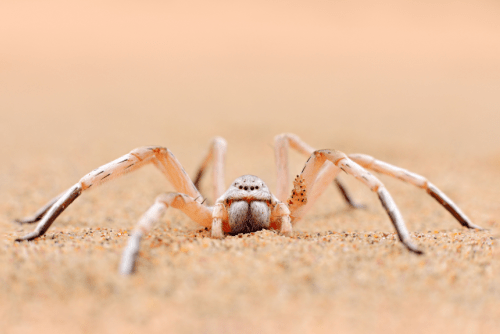
The golden rolling spider resides in the sandy deserts of Namibia. When provoked by predators like spider-hunting wasps, it uses its unique cartwheeling talents (known as flic-flac jumps) to propel itself down the sandy dunes. These flic-flacking rolls are a convenient and quick means of escape, as a golden rolling spider can travel up to one and a half meters per second as it rolls down a dune.
The golden rolling spider.
The Flic-Flac Spider
The flic-flac spider also lives in sandy regions, specifically in the southern sand-filled deserts of Morocco. Recently discovered by spider expert Dr. Peter Jäger, the flic-flac spider (Cebrennus rechenbergi) is known for its gymnast-like agility as it jumps and rolls to expedite its travel time.
Unlike its cartwheeling cousin, the flic-flac spider uses extreme flexibility to propel itself off the ground. It takes advantage of its flic-flacking skills to travel downhill, uphill, or on flat ground at two meters per second.
How Do Diving Bell Spiders Live and Travel Underwater?
While you may have spent a small chunk of your childhood boasting your ability to hold your breath for over a minute in the pool, can you imagine what it would be like living your entire life underwater?
Enter the Argyroneta aquatica, more commonly known by its informal name, the diving bell spider. Like humans, this species needs oxygen to breathe — so how is it possible that they can spend up to 24 hours underwater at a time?
Diving bell spiders use their multipurpose silks to create tiny silk-made air tanks (diving bells) that attach to pond weeds or the sides of aquariums. After creating their homemade oxygen chambers, they return to the water’s surface, grab an air bubble, attach it to the bottom of their hairy abdomens, and swim to their diving bell, where they deposit the bubble.
With such an efficient method of living and breathing underwater, diving bell spiders can enjoy an entirely sub-aquatic existence that includes swimming, eating and breeding.
A diving bell spider
Spider Travel FAQs
Can spiders really fly? Spiders do not have wings, but some species can travel through the air using a technique called ballooning. By releasing silk that catches air currents and electric fields, they can become temporarily airborne.
How far can spiders travel by ballooning? Some spiders have been observed traveling several miles and reaching heights of thousands of feet, depending on atmospheric conditions.
Can spiders live underwater? Yes. The diving bell spider (Argyroneta aquatica) is the only spider species known to spend nearly its entire life underwater.
Why do some spiders cartwheel? Cartwheeling helps certain desert spiders escape predators quickly, especially when moving downhill across sand dunes.
Expand Your Knowledge of Spiders, Insects and More at the University of Florida
Whether you’re interested in diving deeper into the inner workings of spiders or looking for a broader education in insects and other arthropods, the University of Florida offers a wide variety of entirely online programs. Each program is built to expand your knowledge of entomology and point you on a path to help build your career in a variety of fields, including:
Agriculture has a workforce most people never see (and no, it’s not just agronomists or agricultural engineers). It’s insects. Quietly and consistently — without paychecks or benefits — insects pollinate crops, control pest populations and help food systems function. Understanding their role goes beyond appreciation. It’s a reminder that biodiversity in agriculture depends on more than what we plant in the field. …
Insects can’t be trained — at least not in the way you’re thinking of. No pats on the head for fetching a tiny ball or flying to a certain spot on command. But research on hoverflies is challenging what entomologists thought they knew about insect learning. These small, bee-mimicking insects are helping researchers understand how visual information shapes decision-making…
Disaster preparedness planning usually focuses on evacuation routes, emergency supply kits and shelter plans. Insects rarely make the list. But after a hurricane or flood, insect populations aren’t waiting for communities to catch up. Mosquito numbers spike. New breeding sites appear overnight. Disease risks increase. That’s why entomology plays a crucial role in emergency management planning. By monitoring insect populations and identifying potential disease…