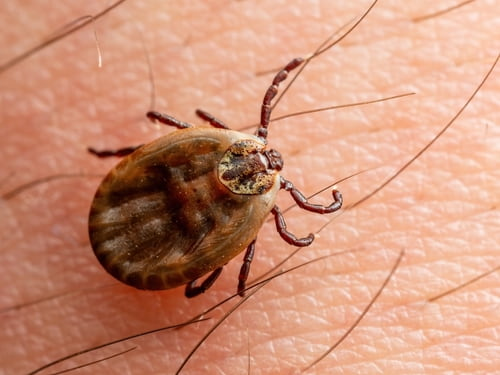
Ticks. They’re creepy, they’re crawly — and if you’ve ever gone hiking, you’re probably familiar with the idea of doing a “tick check” afterward. You may have even Googled things like “how to remove a tick” — just in case. Known for carrying and transmitting Lyme disease, these bloodsucking arachnids have earned a notorious reputation.
But how did ticks evolve to rely on blood for survival? And how are these adaptations informing today’s research in entomology and disease ecology?
Let’s find out.
How Have Ticks Evolved?
According to fossil records, Ixodidae—the order today’s hard ticks belong to—emerged during the Cretaceous period, about 100 million years ago. (So yes, they likely fed on feathered dinosaurs.)
And while ticks are arachnids, that doesn’t make them spiders. Sure, they have eight legs like their spider cousins, but their biology, behavior and ecological roles are quite different.
Tick Classification
Ticks are classified into three families: Ixodidae (hard ticks), Argasidae (soft ticks) and Nuttalliellidae (a rare, ancient group with only one species).
The earliest true ticks were already obligate blood-feeders, meaning they needed blood to survive. But before they evolved into the highly specialized parasites we know today, their ancestors (free-living mites), likely led a very different lifestyle.
These ancient relatives probably scavenged organic material or fed on decomposing insects in the soil. Over time, they evolved into blood-feeding ticks, a major shift likely driven by access to a more consistent and nutrient-rich food source: vertebrate blood.
Why Did Ticks Switch from Scavengers to Blood-Feeders?
Ticks transitioned from scavenging to blood-feeding because blood is a more nutrient-rich and reliable food source. This adaptation gave them a powerful survival advantage and supported their evolution into successful parasites.
But it wasn’t just about easy calories. Other evolutionary factors helped hematophagy (blood-feeding) become ticks’ go-to survival strategy:
Access to new hosts Once ticks began feeding on live animals, their dining options expanded. Birds, reptiles and mammals all became mobile food sources.
Greater mobility and survival Ticks that could hitch a ride on their hosts were able to travel farther and settle into new habitats, increasing their chances of survival and global spread.
Gradual specialization This evolutionary transition didn’t happen overnight. Some ancestral mites may have started on fluids from wounds or soft tissue. Over time, natural selection favored traits that made full blood-feeding more effective. Eventually, these adaptations gave rise to the distinct group we now recognize as ticks.
The Evolution of Tick Saliva and Mouthparts
Through years of evolution, ticks have developed characteristics that help them successfully thrive on blood. These specialized changes help them:
Cut through skin
Stay attached to their host
Remain unnoticed while feeding
Prevent blood from clotting
So how do they do it? Mostly, through two major adaptations: piercing mouthparts and anticoagulant saliva.
Piercing Mouth Parts
Ticks may not have sharp vampire-like fangs, but they do have something even more cunning: the ability to stay attached to their prey for hours (or even days) without being noticed.
That’s why their feeding structure evolved into a system called the capitulum, which includes three key components:
Palps: Sensory feelers that help the tick find a feeding site, but don’t pierce the skin
Chelicerae: Tiny, blade-like structures that saw through the host’s skin
Hypostome: A barbed, straw-like structure that anchors the tick and allows it to drink blood
Anticoagulant Saliva
Without the right chemicals on standby, it would be much harder for ticks to efficiently feed every time they find a host. That’s because vertebrates, like humans and other mammals, respond to injuries with clotting, inflammation and the feeling of pain.
So, over millions of years, tick saliva evolved into a complex chemical cocktail designed to quietly counteract those defenses. Inside that saliva, you’ll find:
Anticoagulants, to stop the host’s blood from clotting
Vasodilators, to open blood vessels wider to improve flow
Immunosuppressants, to quiet the immune system so the host doesn’t detect them
Pain blockers, to prevent itching, pain or other sensations around the bite
Turn Curiosity Into Entomology Expertise
Want to keep learning about insects, pests and the science behind how they affect our world? UF has online programs for that.
Ticks are tiny. The problems they cause? Not so much. These tiny arachnids — about the size of an apple seed — spread more vector-borne diseases than almost any other insect. Lyme disease alone is diagnosed and treated in roughly 476,000 Americans each year, according to the U.S. Centers for Disease Control and Prevention (CDC). And recently, emergency room…
A squirming larva that screws itself deeper into living flesh as it feeds? Yeah, a screwworm sound like something a horror writer invented after a very bad camping trip. Unfortunately, they’re real. Even more unfortunately, they’re flies. The New World Screwworm (NWS) is a parasitic fly whose larvae (maggots) can infest wounds and feed on…
Traveling exposes you to a lot of new experiences, like stumbling upon the best street food you’ve ever had. That’s part of what makes it worthwhile. But some surprises are worth getting ahead of, and vector-borne diseases are at the top of that list. Sure, you can’t avoid bugs entirely, but you can make yourself a much harder target. That takes preparation and a…